Contents
Imagine two people walk into a hardware store.
The first one says: “I want to build a house. Give me wood, nails, a saw, and total creative freedom.” The second one says: “I just need somewhere to live by Friday. Do you have anything pre-built I can move into?”
Neither of them is wrong. They just want completely different things, and yet somehow, every year, thousands of business owners end up arguing about which one of them made the better choice, as if there’s a universal right answer. There isn’t. But there is a right answer for you, and that’s what we’re actually here to figure out.
The Case for WordPress: Build Anything, Own Everything#
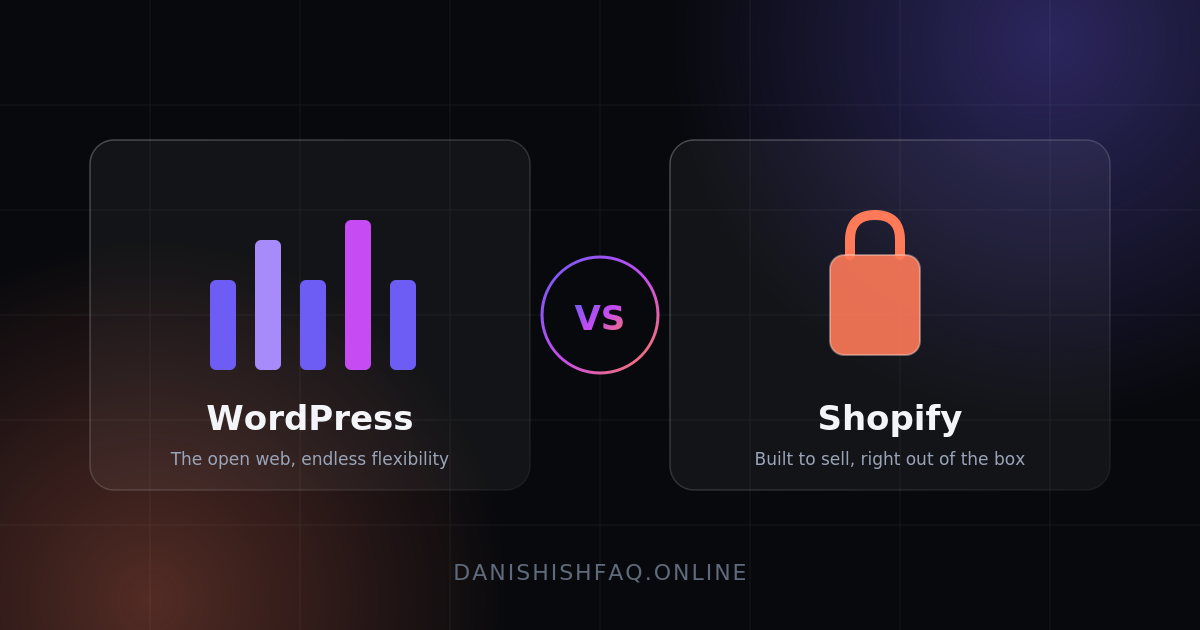
WordPress is the hardware store. It powers something like 40% of the entire internet, from tiny personal blogs to Fortune 500 company sites, because it doesn’t force you into a box. You want a blog? Sure. A membership site? Fine. A directory, a job board, a recipe archive with a built-in meal planner? WordPress shrugs and says “there’s a plugin for that” (there are over 60,000 of them, in case you were wondering).
Here’s the thing people don’t tell you about WordPress: it’s not really one product. It’s a foundation. You are the general contractor. That’s incredibly powerful if you know what you’re doing, or if you hire someone who does. But it’s also exactly why WordPress sites can go sideways. I’ve inherited WordPress sites running fourteen different plugins that all quietly hate each other, held together with duct tape and a prayer, loading slower than a dial-up modem in 2003.
WordPress rewards intention. If you (or your developer) actually plan the build, with the right hosting, the right theme, minimal plugin bloat, and proper caching, it can be blisteringly fast and endlessly flexible. If you just click-install fifteen plugins because a YouTube video told you to, it becomes the Frankenstein’s monster of the internet.
The Case for Shopify: Move In Tomorrow#
Now picture the second customer. Shopify is the “move-in-ready house.” You’re not building a home from raw materials. You’re picking from beautiful, pre-designed layouts, and everything you need to actually sell things is already wired in: checkout, payment processing, tax calculation, shipping rates, abandoned cart emails, inventory tracking. It’s all just there.
This is the entire point of Shopify, and it’s a genuinely brilliant one: e-commerce is hard, and Shopify has already solved the boring but critical 80% of it so you can focus on the 20% that’s actually your business: your products, your brand, your customers.
The tradeoff is the same one you’d expect from any pre-built house. You can repaint the walls, swap the furniture, even knock down a few interior walls with custom apps and Liquid theme code. But you’re not pouring your own foundation. You live within Shopify’s structure, their app ecosystem, and yes, their monthly fee and transaction cut, for as long as you’re a tenant.
So Which One Actually Wins?#
Here’s where I’m going to disappoint the people who wanted a dramatic verdict: it depends entirely on what you’re building, not which platform is “better.”
Pick Shopify if:
- You’re primarily selling physical or digital products
- You want to launch fast and don’t want to think about server maintenance, security patches, or “why is my site down at 2am”
- You value a clean, proven checkout experience over infinite customization
- You’re a solo founder or small team without a dedicated developer on call
Pick WordPress if:
- Content is as important to your business as, or more important than, selling: think blogs, resources, community, SEO-driven organic growth
- You need something Shopify’s ecosystem doesn’t offer out of the box, and you’re willing to invest in custom development to get it
- You want full ownership of your code, your data, and your hosting, with zero platform lock-in
- You’re playing a long SEO game where content architecture and site structure actually matter (and if you’re reading a blog about SEO, that’s probably you)
The Plot Twist Nobody Mentions#
Here’s something most “WordPress vs Shopify” articles conveniently skip: you don’t actually have to choose just one.
A growing number of serious businesses run WooCommerce (WordPress’s e-commerce plugin) when they need deep content and commerce intertwined. Think of a coffee brand with an extensive blog about sourcing and brewing, selling product directly from content-rich pages. Others run Shopify for the store and a separate WordPress blog for content and SEO, connecting the two. Increasingly, people are going headless: using WordPress purely as a content engine (exactly what powers the blog you’re reading right now) and pairing it with a custom-built, blazing-fast frontend that isn’t tied to either platform’s limitations.
That last option is quietly becoming the smart middle ground. It gives you WordPress’s flexibility for content and SEO, without inheriting the theme bloat and plugin chaos that gives WordPress its bad reputation.
The Real Question#
Stop asking “which platform is better” and start asking: “What does my business actually need to do, and which house am I willing to either build or move into?”
If you want to sell products with minimum fuss, Shopify will treat you well. If content, SEO, and total flexibility matter more than a quick launch, WordPress, done properly, by someone who won’t turn it into plugin soup, is the stronger long-term foundation.
And if you’re not sure which one fits? That’s usually the moment to talk to someone who’s built on both, rather than guessing based on a YouTube thumbnail that promised you “the ONE platform you need in 2026.” There isn’t one. There’s the one that fits your house.
I build fast Shopify stores and WordPress sites with technical SEO engineered in, and AI automation that takes repetitive work off your team.
Need help with your Shopify store, WordPress site or AI automation?
Tell me what you’re working on, or start with a free audit of your site.