Contents
Imagine you need a suit for a big event next week.
Option one: you walk into a department store, grab something off the rack in your general size, and a tailor there does some quick alterations, hemming the pants, taking in the waist. Done in a day, looks good, costs a reasonable amount.
Option two: you go to a bespoke tailor. They take dozens of measurements, hand-select the fabric, and build a suit that fits you and only you, stitch by stitch. It takes weeks. It costs considerably more. But when you put it on, it fits like nothing else you own ever will.
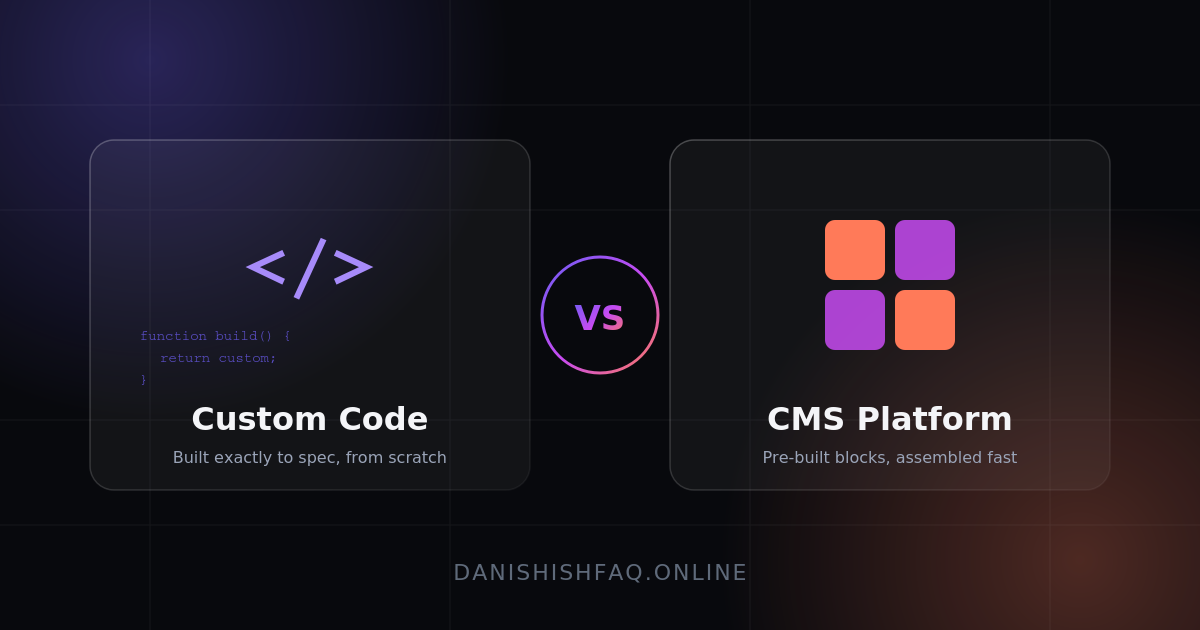
Neither person made a mistake. They just had different timelines, budgets, and standards for “good enough.” This is, almost exactly, the real difference between a CMS website and a custom-coded one, and it’s a much more useful way to think about it than the usual “which is better” framing that dominates this debate online.
The Department Store: CMS Platforms (WordPress, Shopify, Wix, Webflow, and friends)#
A CMS gives you the rack of pre-made suits: themes, templates, drag-and-drop builders, plugins for almost anything you can imagine needing. Someone else has already solved the hard structural problems, like how the grid responds on mobile, how the checkout flow works, how the blog pagination behaves. You’re not reinventing any of that. You’re selecting, configuring, and lightly tailoring.
This is enormously valuable, and I say that as someone who builds custom sites for a living. Most businesses do not need, and genuinely cannot justify the cost of, a fully bespoke build. If you need a professional site live in two weeks on a modest budget, a well-configured CMS site, built by someone who actually knows what they’re doing (not just fifteen plugins duct-taped together), will serve you extremely well.
The tradeoff is the one you’d expect. You’re working within someone else’s structure. Want a genuinely unique interaction, an unusual layout, a specific performance optimization the platform wasn’t built for? You’ll be fighting the platform’s assumptions the whole way, like asking a department store tailor to add a secret inner pocket that wasn’t part of the original pattern. Sometimes they can. Often, it’s more trouble than it’s worth.
The Bespoke Tailor: Custom-Coded Websites#
A custom-coded site starts from nothing but a blank canvas and your actual requirements. No theme fighting you. No plugin doing 90% of what you need and 10% of something you didn’t ask for. No mystery CSS three layers deep in a framework you didn’t write, that you now have to fight to override.
This is where real performance gains live. The fastest, leanest sites on the internet are almost always custom-built, because every byte sent to the browser was a deliberate choice, not an accident of “well, the theme just does that.” When Core Web Vitals and page speed genuinely matter to your business, and increasingly, they matter to your Google rankings too, custom code has a ceiling that CMS platforms simply can’t match, no matter how well-optimized the CMS site is.
The honest tradeoff: it costs more, takes longer, and once it’s built, adding new features later means development work, not clicking “install plugin.” You’re not renting flexibility off the rack. You’re paying for it upfront, in exchange for a fit nothing else can replicate.
The Uncomfortable Middle Ground Everyone Skips#
Here’s what almost nobody tells you: the smartest builds today are often neither pure option.
This exact site is a good example. The content, blog posts, the kind of thing that changes often and benefits from an easy editing interface, lives in WordPress, a CMS, because rewriting a content management system from scratch would be a genuinely silly use of time and money. But the actual frontend people experience, the part where speed and precision actually matter to a visitor and to Google, is custom-coded, tailored specifically to be fast, structured, and exactly as designed, with zero theme bloat weighing it down.
This “headless” approach is quietly becoming the serious answer for a lot of businesses: the department store’s efficiency for the parts that don’t need bespoke treatment, and the tailor’s precision for the parts that genuinely do.
So Which One Should You Actually Choose?#
Ask yourself these questions honestly:
Choose a CMS if:
- Your timeline and budget are both meaningfully constrained
- Your needs are largely covered by existing themes, templates, or plugins
- You (or your team) want to update content yourselves without calling a developer every time
- “Good and fast to launch” beats “perfect and slow to launch” for your situation right now
Choose custom code if:
- Performance is a competitive advantage in your industry, not a nice-to-have
- You have specific, unusual requirements that don’t map cleanly onto existing platforms
- You’re building something meant to scale significantly, where technical debt from a CMS would become expensive later
- You value long-term ownership over short-term convenience
Consider a hybrid (headless) approach if:
- You want CMS-level ease of content editing and custom-level frontend performance
- You’re serious about SEO and site speed, but don’t want to give up an easy publishing workflow
- You’re willing to invest a bit more upfront for a setup that scales cleanly later
The Real Takeaway#
There’s no universal winner here, and anyone who tells you otherwise is usually trying to sell you whichever one they specialize in. The department store suit and the bespoke suit both get you dressed for the event. The only real question is what you’re optimizing for, speed and budget, or precision and performance, and, if you’re smart about it, whether you actually need both at once.
I build fast Shopify stores and WordPress sites with technical SEO engineered in, and AI automation that takes repetitive work off your team.
Need help with your Shopify store, WordPress site or AI automation?
Tell me what you’re working on, or start with a free audit of your site.